DESCRIPTION
Upper Elementary Physics is a complete, full-year, hands-on science curriculum designed for students in grades 3-7. Through six Science Unlocked modules, students explore forces, motion, magnetism, energy, waves, light, and electricity while asking questions, analyzing evidence, and building scientific understanding through hands-on learning.
The full-year curriculum includes:
- Full-color Student Workbooks
- Teacher Guides with step-by-step teaching support
- Student assessments
- Required science materials for hands-on investigations
- Suggested schedules and lesson-planning guidance
- Support for teaching students of different ages and abilities
No science background is required. Each module includes an easy-to-use Teacher Guide that helps parents understand the science behind each lesson, guide hands-on investigations, evaluate student responses, and support meaningful scientific discussion.
The Upper Elementary Physics Full-Year Curriculum includes the following six modules:
Force and Motion
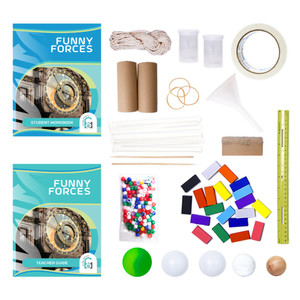
Module 1: Funny Forces
Incredible Inventions with Simple Machines
Experiment with air pressure, discover simple machines in everyday objects, and design an invention that puts these concepts to work.
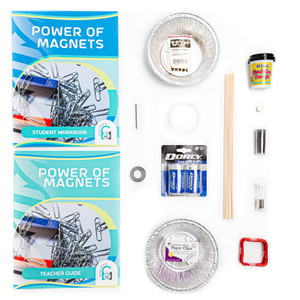
Module 2: Power of Magnets
Investigations into Magnetic Fields and Forces
Explore magnetic fields and forces through hands-on activities that demonstrate how magnets interact with different materials and with each other.
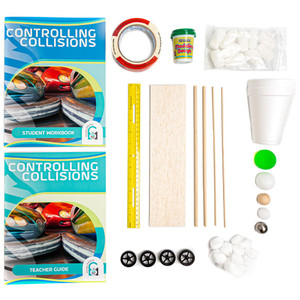
Module 3: Controlling Collisions
Energy Transfer and Design
Test how materials and structural design affect an object's ability to withstand collisions and manage energy transfer.
Energy and Waves
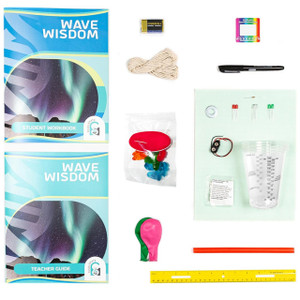
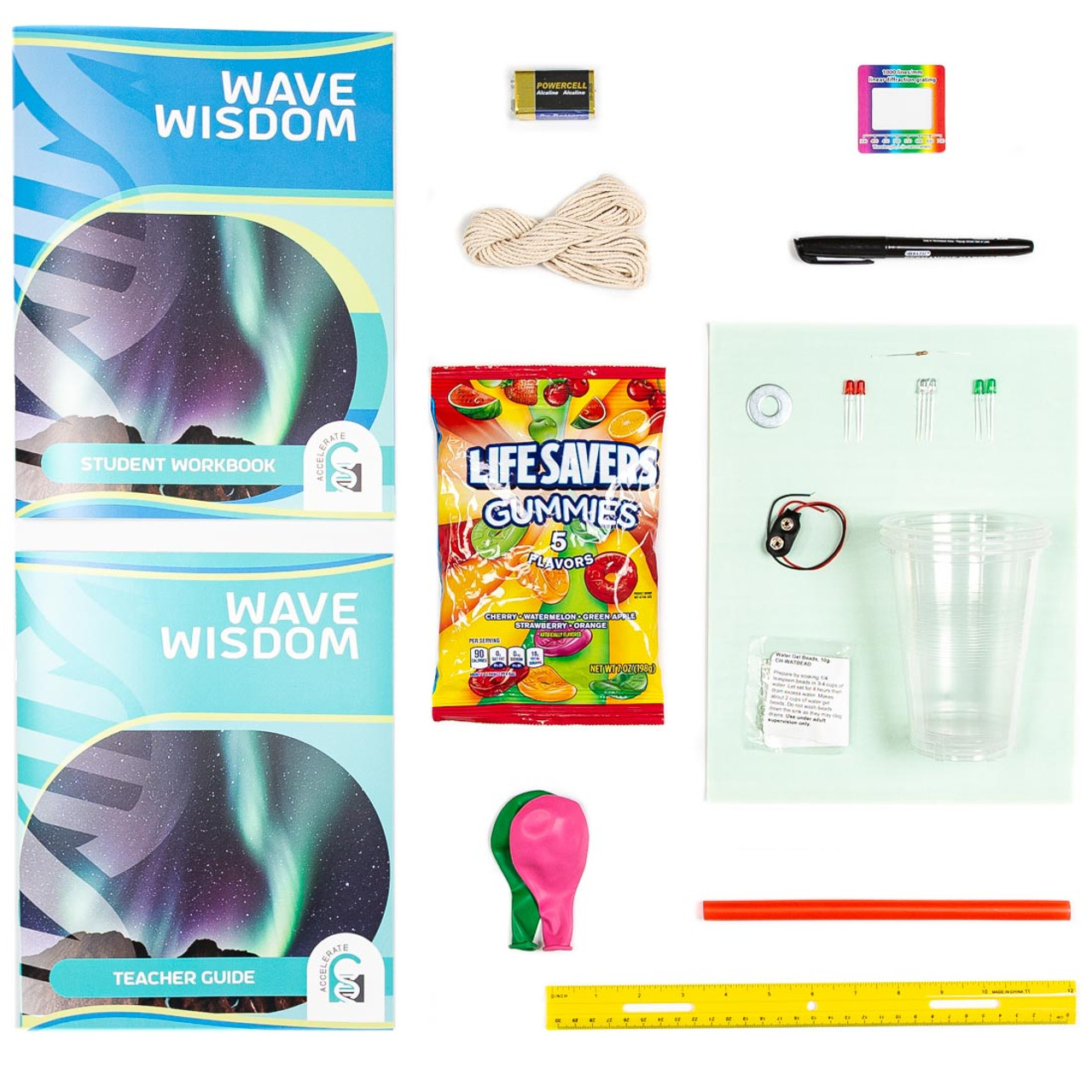
Module 4: Wave Wisdom
Patterns of Energy and Information Transfer
Explore how waves transfer energy and information through activities with water, light, and microwaves.
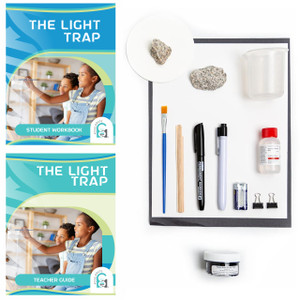
Module 5: The Light Trap
Investigating Light and Pigments
Examine light's role in energy transfer and sight and discover how pigments connect science, art, and society.

Module 6: No Wires Necessary
Exploring Electricity with Circuits
Test the conductivity of different materials, compare series and parallel circuits, and design a model circuit for a home.
More information about the learning objectives in each module can be found in the contents section below. This NAPPA Award-winning NGSS physics curriculum is based on NGSS science standards for 3rd through 7th grade science education. Read the contents section below to learn more about the standards met in each module.
Where does this curriculum fit in Science Unlocked?
Upper Elementary Physics is part of Accelerate, the Science Unlocked level for grades 3-7. Accelerate builds on the foundation established in Wonder while helping students develop greater independence through hands-on, inquiry-first science.
What comes next?
Continue through the Accelerate pathway with the science discipline recommended for your student's next grade level.
MORE INFORMATION BOX
CONTENTS
This Accelerate level Science Unlocked full-year curriculum includes the following modules:
Extra student workbooks for this curriculum are available.
SCIENCE STANDARDS
- Learning outcome: Push, pull, and play your way to understanding force. Experiment with air pressure, discover simple machines in everyday items, and design your own incredible invention.
- NGSS science standards alignment
- 3-PS2-1 Plan and conduct an investigation to provide evidence of the effects of balanced and unbalanced forces on the motion of an object.
- 3-PS2-2 Make observations and/or measurements of an object's motion to provide evidence that a pattern can be used to predict future motion.
- 5-PS2-1 Support an argument that the gravitational force exerted by Earth on objects is directed down.
- Learning outcome: Feel the pull toward this physics kit and get hands-on with magnets to find out what they can do and how they do it.
- NGSS science standards alignment
- 3-PS2-3 Ask questions to determine cause and effect relationships of electric or magnetic interactions between two objects not in contact with each other.
- 3-PS2-4 Define a simple design problem that can be solved by applying scientific ideas about magnets.
- MS-PS2-3 Ask questions about data to determine the factors that affect the strength of electric and magnetic forces.
- MS-PS2-5 Conduct an investigation and evaluate the experimental design to provide evidence that fields exist between objects exerting forces on each other even though the objects are not in contact.
- Learning outcome: Crash into this physics kit to learn how materials and the structure of design impact the ability to withstand collisions.
- NGSS science standards alignment
- 3-5-ETS1-2 Generate and compare multiple possible solutions to a problem based on how well each is likely to meet the criteria and constraints of the problem.
- 3-5-ETS1-3 Plan and carry out fair tests in which variables are controlled, and failure points are considered to identify aspects of a model or prototype that can be improved.
- 4-PS3-1 Use evidence to construct an explanation relating the speed of an object to the energy of that object.
- 4-PS3-3 Ask questions and predict outcomes about the changes in energy that occur when objects collide.
- 4-PS3-4 Apply scientific ideas to design, test, and refine a device that converts energy from one form to another.
- MS-PS3-1 Construct and interpret graphical displays of data to describe the relationships of kinetic energy to the mass of an object and to the speed of an object.
- MS-PS3-5 Construct, use, and present arguments to support the claim that when the kinetic energy of an object changes, energy is transferred to or from the object.
- Learning outcome: It's nothing but good vibes here – learn what waves are, what they do, and how people use them by doing some wavy water tricks, making gummies glow, and "catching" microwaves.
- NGSS science standards alignment
- 4-PS4-1 Develop a model of waves to describe patterns in terms of amplitude and wavelength, and that waves can cause objects to move.
- 4-PS4-3 Generate and compare multiple solutions that use patterns to transfer information.
- MS-PS4-1 Use mathematical representations to describe a simple model for waves that includes how the amplitude of a wave is related to the energy in a wave.
- MS-PS4-2 Develop and use a model to describe that waves are reflected, absorbed, or transmitted through various materials
- Learning outcome: Investigate light's role in energy transfer and sight, and find out how pigments connect science, art, and society.
- NGSS science standards alignment
- 4-PS3-2 Make observations to provide evidence that energy can be transferred from place to place by sound, light, heat, and electric currents.
- 4-PS4-2 Develop a model to describe that light reflecting from objects and entering the eye allows objects to be seen.
- 5-PS1-1 Develop a model to describe that matter is made of particles too small to be seen.
- MS-PS1-3 Gather and make sense of information to describe that synthetic materials come from natural resources and impact society.
- Learning outcome: Does electricity need wires to work? Find out by investigating the conductivity of materials, testing parallel and series circuits, and designing a model circuit of a home.
- NGSS science standards alignment
- MS-ETS1-2 Evaluate competing design solutions using a systematic process to determine how well they meet the criteria and constraints of the problem.






 Warning