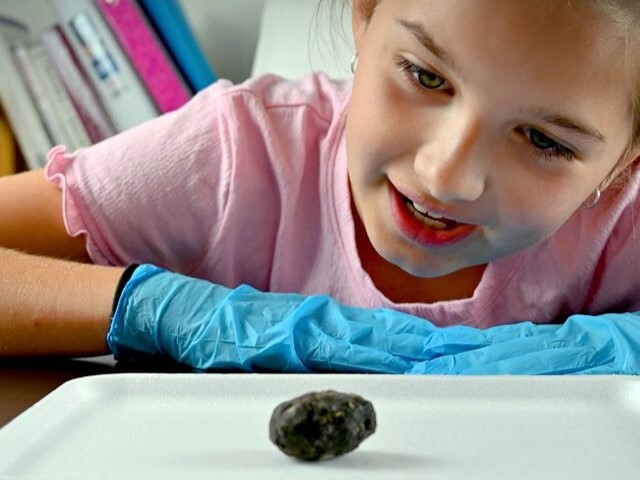
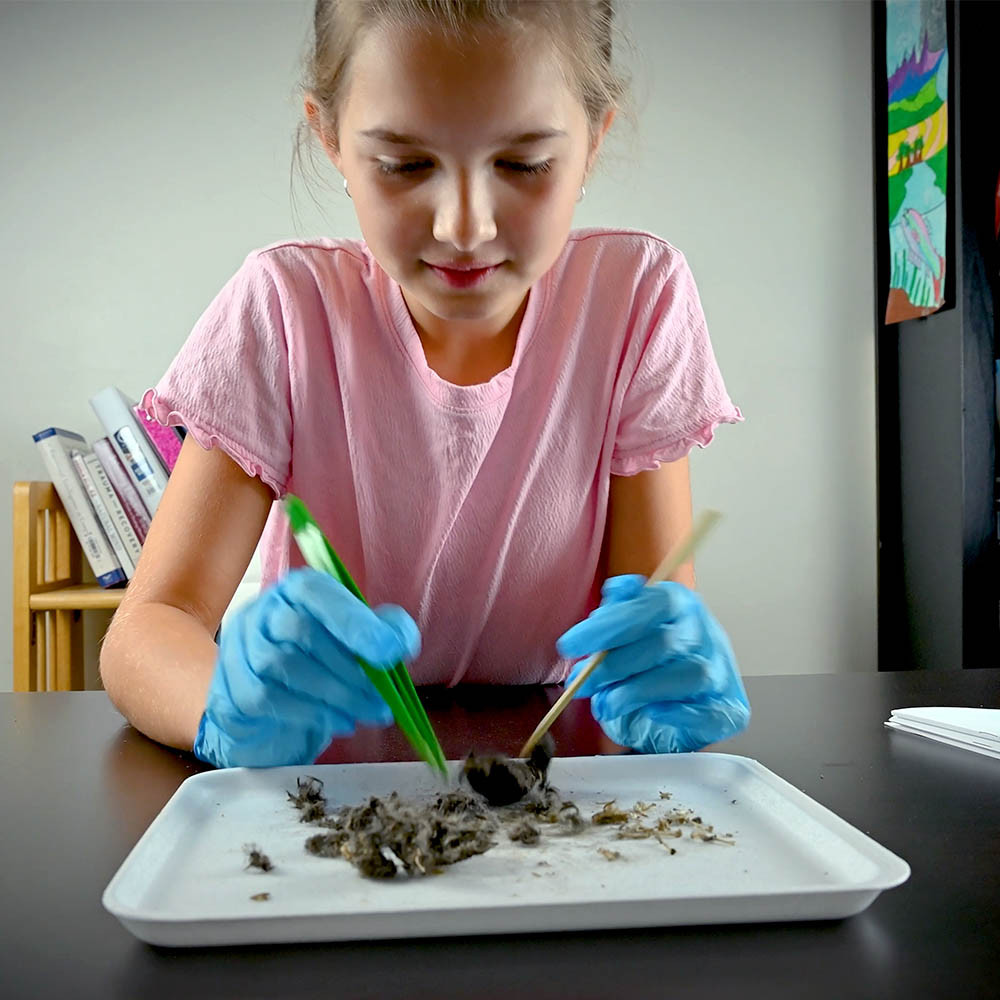
Pull apart a real owl pellet and uncover the bones inside with our Owl Pellet Dissection Kit—a classic, hands-on life science experience that brings food webs and ecosystems to life. Students dissect a large, sterilized barn owl pellet, identify the bones of the owl's prey using the included identification key, and reconstruct a picture of the owl's place in the food chain. Everything needed for a complete dissection is included:
- Real barn owl pellet (1½" or larger), foil wrapped and dry heat sterilized
- All dissection tools included—forceps, skewer, magnifying glass, petri dishes, and dissecting tray
- Bone identification key and sorting chart for identifying skulls, jawbones, and other prey remains
- Student manual and teacher's guide with background on food chains, food webs, and owl biology
- Works for elementary through high school—adaptable for any level of science study
 |
A Great First Dissection for Younger Students
Owl pellet dissection offers all the excitement of a real dissection activity without the complexity—making it a perfect introduction to hands-on life science for elementary and middle school students.
|
- Owl pellet (1½" or larger, foil wrapped and dry heat sterilized)
- Dissecting tray
- Forceps
- Skewer
- Magnifying glass
- 2 Petri dishes
- 2 Pairs of gloves
- Ruler
- Card stock
- Index card
- Crayons (pack)
- Glue
- Zip-close bag
- Student manual
- Teacher's guide
What Is an Owl Pellet—and Why Dissect One?
Owls swallow their prey whole but can't digest bones, fur, or teeth. Instead, their digestive system compacts these materials into a tightly packed mass—called a pellet—that the owl regurgitates. Each pellet is essentially a record of the owl's recent meals, preserved and ready to be studied. Dissecting one gives students a window into the owl's diet, its hunting behavior, and its role in the local ecosystem. It's the same method scientists use to study owl populations in the wild.
This kit uses barn owl pellets, which are among the most informative for dissection. Barn owls hunt in open fields and meadows, feeding primarily on voles, shrews, mice, and other small rodents. Students can use the included bone identification key to sort and identify what they find—and may uncover the remains of more than one animal in a single pellet.
What Students Learn
Owl pellet dissection naturally connects to core life science concepts. Through this activity, students explore food chains and food webs, predator-prey relationships, animal adaptations, and the role of raptors in ecosystem balance. The included teacher's guide supports lesson planning with background information and discussion questions. Some good questions to explore: How many different prey animals can you find in one pellet? What does the variety of bones tell you about the barn owl's diet? Can you construct a complete food chain starting with the owl?
This kit works well for a wide range of ages and settings. Younger students enjoy the hands-on discovery of identifying bones; older students can extend the activity into data collection, food web diagrams, or biomass analysis. For a full guided activity with step-by-step instructions, visit our Owl Pellet Lab dissection project. Need pellets for a group? This kit is also available as a 5-pack or a 20-pack classroom kit.
Safety Information
All owl pellets in this kit have been dry heat sterilized for a minimum of 4 hours at 250°F to eliminate bacteria and viruses. Even so, we recommend following these handling guidelines:
- Work away from eating or food preparation areas.
- Wear the included gloves during dissection and cleanup. Additional latex gloves or nitrile gloves are available if needed.
- Use the included dissecting tray—do not dissect directly on desks or tabletops. A disposable tray also works well.
- Use only the provided dissection tools; do not substitute pencils or other personal items. Plastic forceps are a favorite with younger students.
- Clean work surfaces with a sanitizing solution (household bleach diluted 1:10 works well) when finished.
- Wash hands thoroughly with soap and water after completing the activity.
Frequently Asked Questions
- What grade level is owl pellet dissection appropriate for? Owl pellet dissection works well across a wide range of ages—typically grades 3 through 12. Younger students (grades 3–5) enjoy the hands-on discovery and bone identification, while middle and high school students can extend the activity to explore food webs, trophic levels, and energy transfer in ecosystems. The included student manual and teacher's guide help tailor the experience to your student's level.
- Are owl pellets safe to handle? Yes, with basic precautions. The pellets in this kit have been dry heat sterilized at 250°F for a minimum of 4 hours, which eliminates bacteria and viruses. Gloves are included, and we recommend working away from food areas and washing hands thoroughly after the activity—the same precautions you'd take with any science lab.
- What bones will we find inside an owl pellet? Most barn owl pellets contain the remains of small rodents—commonly voles, mice, and shrews. You may find skulls, jawbones, vertebrae, ribs, and leg bones. The included bone identification key and sorting chart help students match what they find to the prey species the owl was eating. It's common to find the remains of more than one animal in a single large pellet.
- What science concepts does owl pellet dissection teach? Owl pellet dissection is one of the most effective hands-on activities for teaching food chains and food webs, predator-prey relationships, animal adaptations, and ecological roles. It also introduces students to real scientific methods—observation, data collection, and classification—in a concrete and memorable way. These topics align with NGSS life science standards at multiple grade levels.





 Warning